




Geopolitics is becoming more and more uncertain. As the US and China leverage their economic might, the EU is increasingly focused on de-risking from the two countries.
The US has dominated headlines recently with their attacks on Iran and Trump’s incendiary remarks on European allies who are reluctant to support. The White House has persisted in its weaponisation of trade. But many believe that China still poses a bigger threat.
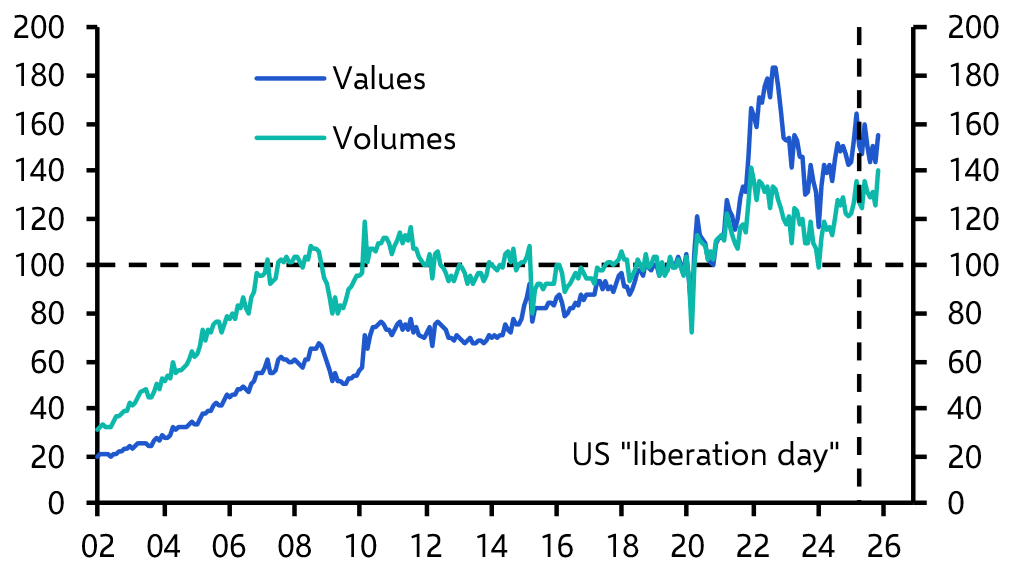
Just this month the EU implemented the Industrial Accelerator Act on 04 March and introduced a “Made in Europe” policy aimed at boosting Europe’s industrial base. The act puts minimum requirements of EU-origin in place for key industries like electric vehicles and raw materials with the explicit goal to “avoid cheap Chinese imports.”
Euro-zone Imports from China (2019 = 100)
Source: Capital Economics
James Green, Research Fellow at the Centre for European Reform said the IAA also “includes language that would provide greater scrutiny over greenfield investments,”. These are Foreign Direct Investments where a parent company opens a subsidiary in a foreign country, building new facilities rather than acquiring existing ones. “While the language doesn’t specify China, it’s safe to say the provisions are targeted towards China” Green said.
He pointed to an ongoing negotiation between Spain and Chinese battery manufacturer CATL regarding the import of 2,000 Chinese workers for the construction of a new manufacturing plant. “If you’re importing that much labour, it’s unclear the degree to which there’s going to be the type of local benefit you would like with an FDI project” Green said.
He explained that “Europe, both at the member state and the EU level, needs to be conscious of whether and how these Chinese firms building and operating in Europe does or does not create value for local communities and the broader single market.”
Nonetheless, recent developments concerning the US have also shown a need for the EU to reduce its dependence on the American market. When Spanish Prime Minister Pedro Sánchez refused to allow the US to use the jointly run bases at Morón and Rotafor in its attacks on Iran, US President Donald Trump threatened to cut off all trade with Spain as a result.
Source: Dawn News, Diario AS
“Spain has been terrible” Trump told German Chancellor Frierich Merz earlier this month. “We’re going to cut off all trade with Spain,” he said. Though no official sanctions or embargos have come into effect.
Markus Gehring, Professor of Law at Cambridge University and member of the Centre for European Legal studies said that many countries in the EU underestimated the threat Trump’s administration poses. “The EU was still very diplomatic with the Trump administration” following its “Liberation Day” tariffs, he said.
That all changed in January this year when Trump threatened to take Greenland for “national security reasons”, threatening further tariffs and even refusing to rule out military action. Gehring said threatening Greenland with military force was Trump’s biggest strategic mistake which he called a “real turning point” for EU member states. Now “there’s very little appetite to appease the Trump administration.”
The EU Parliament approved a trade deal with the US on 16 March. But put in a clause stating that unless every bit of the deal is implemented by the US, the EU is not obligated to implement their side. “This amendment by the EU parliament shows how little patience there is for their colleagues in America,” Gehring said.
Despite the EU’s frustrations with the US, Gehring believes that the bloc still perceives China as “slightly more threatening”. He said that the EU favours countries with values similar to its own and that “interacting with authoritarian regimes is more difficult for the EU than dealing with a dysfunctional democracy like the one in Washington.”
Rare earth minerals have become one of the most important industries in the global economy. They are used to produce semiconductors, EVs, batteries and many other high-tech goods. Hence, competition for these minerals has become paramount. China not only has access to a large share of these minerals, but its authoritarian regime makes it immune to environmental concerns.
“One of the reasons China has been so successful at capturing the market share isn’t necessarily the mining itself, it’s how dirty the processing is.” said George Riddell, Managing Director at International Trade Advisor Goyder Ltd. He said that the difficulties the EU faces in producing rare earth minerals go beyond cost: “whenever a new project tries to get off the ground in Europe, you see huge grassroots local campaigns saying ‘no we don’t want that sort of activity in our communities’… China doesn’t have that problem.”
From 2023 onwards, China has been putting export bans on critical minerals to “countries they are having trade and broader geopolitical disagreements with.” according to Riddell. In October 2025, the Chinese government extended these restrictions to the technologies involved in mining and producing these elements. They also applied extraterritorial controls requiring foreign companies to apply for a license to export goods if it contains controlled rare earth elements sourced from China representing at least 0.1% of the item’s total value.
This led the EU to establish the European Critical Raw Materials Act in May 2024. It aims to reduce its dependencies on single countries for raw materials by 2030. The act mandates the commission to find a new supply chain for critical raw materials, mainly metals. If the source of a metal is over 80% from one country, they need to diversify.
Riddell however pointed to the economic difficulties of establishing trade deals in a liberal democracy: “There is a tendency within the EU and a lot of liberal democracies where governments can only do so much in that process; it is businesses who trade. Unless you move to a state sponsored model ultimately businesses will only do what they want to do. Governments can nudge them in the right direction, they can put up frameworks and build different partnerships but there is only so far you can go. Governments can want this but unless business agrees it’s not going to happen.”
On this new world of protectionism and intense economic competition, Riddell said “there is no going back” and that the EU must adapt. Gehring seemed to agree saying “in this brave new world of national economic policies, where every country is in it for themselves, maybe the EU needs to be more proactive and not leave it to its own economic actors to secure sustainable supply chains.”