





Rachel Reeves, the Chancellor, allocated an additional £300m investment to health technology to support staff and improve patient services and committed to building 250 new neighbourhood health centres as part of a drive to improve health and welfare services.
Up to 130 of these centres are scheduled to be in place by 2030.
The chancellor also reiterated the party’s manifesto commitment to reduce NHS waiting lists. Reeves underlined the message that improvements in productivity – ‘driving efficiency’ in her words – are key to improvement in public services, including in healthcare.
Previously large increases to health and welfare spending are coupled to a renewed focus on productivity, even as overall public service performance lags pre-pandemic levels, according to the Office for National Statistics.
In a report on her priorities in June, the Resolution Foundation, a think tank, said the chancellor had prioritised health and welfare in her first year, while Education and Justice received less attention.
“After adjusting for rising prices, day-to-day spending per head for other departments have plummeted since 2010-11 – this includes falls of around 20% for Justice, Transport and Local Government”.
More than £217bn is allocated to healthcare, while Welfare takes £333bn in the upcoming year, according to the Budget 2025 published today.
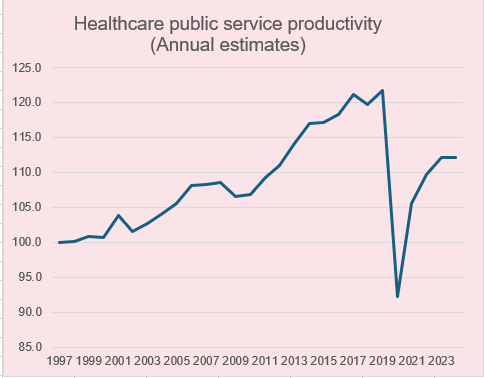
Data from the Office of National Statistics show a marked decline in public service productivity which came with the pandemic.
The graph shows productivity levels in the healthcare and public services in general have yet to recover to 2015 levels.
In her Budget last year, the Chancellor allocated a £29bn to the NHS. Separately, a £3.25bn Transformation Fund for public services was announced in March 2025, with the intention of modernising public services through technology (including digital tech and AI), reductions in bureaucracy to drive efficiency savings.
The Chancellor also emphasised the Government’s determination to address cost of living challenges, with increases to the National Minimum Wage and the National Living Wage – following the advice of the Low Pay Commission – as well as to pensions.